
An unknown number of war criminals migrated to Australia after World War II.
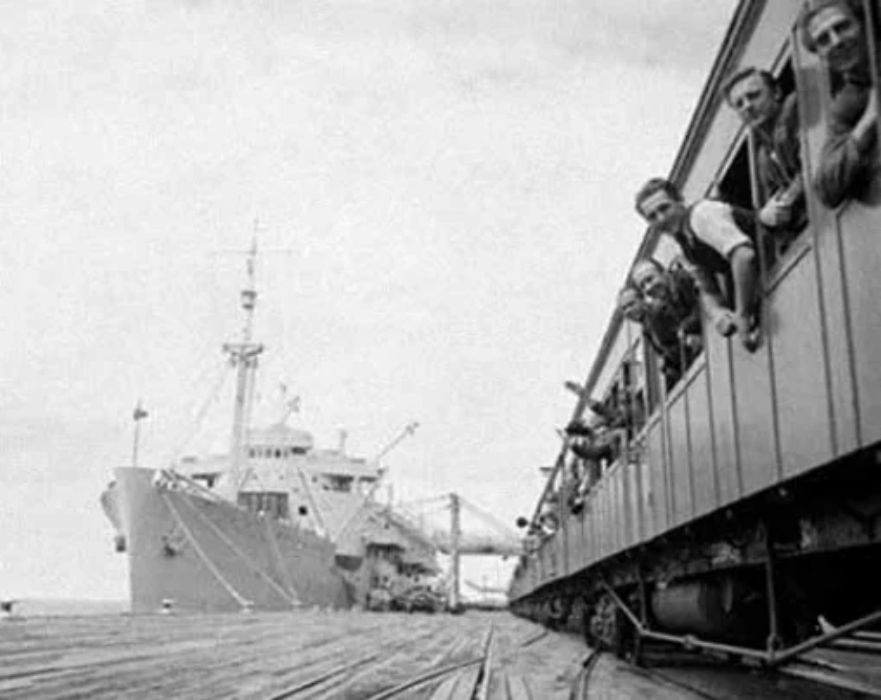
Inadequate screening, combined with the criminals’ lies or withholding of information about their wartime activities, allowed them to join the ranks of emigrants departing war-torn Europe.
Most of the war criminals who came to Australia were from Central and Eastern Europe. Concerns about immigration from these areas were outweighed by a desire to boost Australiaʼs population. Successive Australian governments resisted efforts to investigate, expose or extradite war criminals.
From the late 1970s, journalist Mark Aarons undertook extensive investigations into the presence of war criminals.
In 1986 the Hawke government appointed Andrew Menzies to review the evidence gathered by Aarons and others. Menzies concluded that it was ‘more likely than not that a significant number of persons who committed serious war crimes in World War Two entered Australia and some of these are now in Australia.’ Crucially, Menzies also recommended that the government ‘take appropriate action under the law to bring to justice persons who have committed serious war crimes found in Australia.’
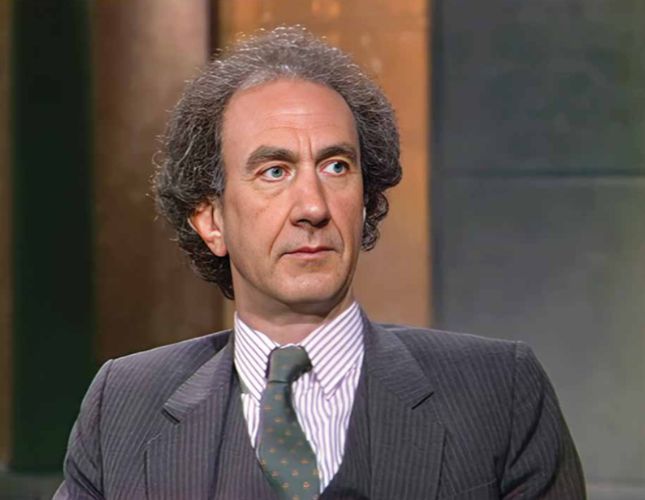
A chance meeting led Mark Aarons to devote decades of his life to investigating the presence of war criminals in Australia.
In 1977 Aarons put the proposition to a senior Australian security contact in Canberra ‘that there was a serious number of Nazi war criminals in Australia, and that Britain and the United States had exported them here, and that the Australian government knew all about them.’

Deputy director and then director of the Special Investigations Unit Graham Blewitt explainshow it was that war criminals were able to make their way to Australia.
Audio: Blewitt.2.How war criminals came to Australia.
Source: State Library of South Australia. Interview with Graham Blewitt. Sound recording,Sydney, 21 November 2023. Interviewer: Peter Monteath. OH 1204/5.
Deputy director and then director of the Special Investigations Unit Graham Blewitt discussesthe motivations of the Hawke government in taking actions against war criminals in Australia.
Audio: Blewitt.3.Motivations of the Hawke government
Source: State Library of South Australia. Interview with Graham Blewitt. Sound recording,Sydney, 21 November 2023. Interviewer: Peter Monteath. OH 1204/5.

Interviewed in 1991, former attorney-general the late Lionel Bowen in an interview with journalist David Bevan discusses the pressures that led the Hawke government to set up the Menzies review and the Special Investigations Unit, and to introduce amended war crimes legislation to parliament. He discusses the long journey of that legislation through the parliament.
Audio: Bowen.1.Hawke government
Source: Recording of interview with former attorney-general Lionel Bowen, May 1991.Interviewer: David Bevan. Private collection.
Former attorney-general the late Lionel Bowen responds to questions from journalist DavidBevan in 1991 about factors considered by the Hawke cabinet in relation to the pursuit of warcriminals.
Audio: Bowen.2.Differing views
Source: Recording of interview with former attorney-general Lionel Bowen, May 1991.Interviewer: David Bevan. Private collection.
SIU investigator John Ralston discusses the circumstances in the 1980s that were conducive tothe pursuit of war criminals.
Audio: Ralston.2.1980s
Source: State Library of South Australia. Interview with John Ralston. Sound recording, Sydney,16 June 2024. Interviewer Peter Monteath. OH 1204/8
The ‘Review of Material Relating to the Entry of Suspected War Criminals into Australia’, commonly referred to as ‘The Menzies Report’, was the outcome of an inquiry commissioned by the Hawke government in 1986. It was conducted by former senior civil servant Andrew Menzies. His task was to determine whether war criminals had entered Australia after World War II and to make recommendations about future measures.
The following is an extract from that Report.
PART IV: FINDINGS AND RECOMMENDATIONS
FINDINGS
On the basis of the material discussed in the preceding Chapters, I now find:
(1) It is more likely than not that a significant number of persons who committed serious war crimes in World War II have entered Australia and some of these are now resident in Australia; certainly the likelihood of this is such that some action needs to be now taken. (Chapter 10).
(2) A large number of allegations that particular persons now in Australia have committed serious war crimes have been noted by the Review and the more significant instanced are recorded in a list that I shall give to the Special Minister of State when delivering this Report with the recommendation that is should not be divulged, except to whatever body si charged with taking further action on this Report. While as much information as is available from official records and other records open to the public has been collated for each person, I have not attempted, because of the nature of the Review, to establish the guilt or innocence of the persons in question; this must be left to further investigation. (Chapter 10).
(3) While Australian officers in Europe endeavoured to prevent the acceptance for migration to Australia of persons responsible for war crimes, and these endeavours must have prevented many war criminals from entering Australia, there were serious limitations, particularly in early years, in numbers and geographical spread of staff available to do the necessary checking and equally serious gaps in the data against which Australian security officers would have made their checks, particularly in relation to non-Germans. These limitations and gaps would have made possible the entry of persons responsible for war crimes although the number of persons so admitted would have been a minute proportion of the enormous number of persons who migrated to Australia in the post war years. (Chapters 5 and 10).
(4) As discussed in Chapter 7, no person admitted into Australia under arrangements with U.K. or U.S. intelligence agencies, to the knowledge of Australian authorities, appears to have been the object of charges or allegations as to commission of war crimes although there is a possibility that, particularly before 1956, former employees of such agencies may have entered Australia without the knowledge of Australian authorities.
(5) A.S.I.O. officers in a number of cases had contact with persons some time after their entry into Australia in respect of whom the Review has recorded allegations of commission of war crimes and obtained information from them for A.S.I.O. purposes not related to the war crimes allegations but there is no evidence that A.S.I.O. was involved in the entry of any of these persons into Australia. (Chapter 7).
(6) It has not been possible to establish definitively how each of the persons in the list referred to in (1) came to be accepted for migration to Australia; however, even assuming their guilt of the charges or allegations, the limitations in numbers and geographical spread of checking staff and gaps in security checking data would, by itself, appear to provide an explanation for the acceptance of these persons. (Chapter 10).
(7) In view of the contentions advanced in the A.B.C. ‘Background Briefing’ series, the Review diligently looked for any evidence that a U.K. or U.S. intelligence officer withheld information from, or otherwise misled, an Australian officer as to commission of war crimes by an applicant for migration to Australia; it found no direct evidence as to this. While I could not establish positively that in no instance this occurred, no evidence was found, in the whole course of the Review, to establish that in any instance a U.K. or U.S. intelligence officer had withheld information from, or misled, Australian officers as to commission of war crimes by applicants for migration to Australia. Generally it would appear that, if any concealment by U.K. or U.S. officers of information as to commission of war crimes by Australian migrant applicants did occur, this would have been confined to a very limited number of cases and the explanation mentioned in (6) (limitations in numbers and geographical spread of Australian checking officers and gaps in checking data) would account for the acceptance for migration to Australia of the overwhelming number of cases of suspected war criminals. (Chapter 9).
(8) The Review found no evidence whatsoever that an Australian officer had knowingly allowed a war criminal to migrate to Australia. (Chapter 2).
(9) Because of time limits and other considerations explained in Chapter 12, it is not possible to prosecute any person named in the list referred to in (2) for any offence committed in relation to his entry into Australia.
(10) The facts as ascertained by the Review did not establish any policy by any Australian Government to allow or assist the entry of known or suspected war criminals into Australia. (Chapter 13).
(11) There is no evidence that any Australian official was involved in any proposal to re-settle Klaus Barbie in Australia. (Chapter 8).
(12) In 1957, the Australian Parliament was given by the then Minister for Immigration incorrect information to the effect that Laszlo Megay had been cleared by the United Nations War Crimes Commission of alleged war crimes. This occurred in consequence of incorrect information having been supplied by U.S. sources to A.S.I.O. (Chapter 6).
(13) Requests from the United States for information concerning war criminals were handled by Australian Departments in an unsatisfactory way and these Departments should have acted in a much more co-ordinated and energetic manner to ensure either that the information sought was provided or the reasons for failing to provide it were communicated without unreasonable delay to the United States. (Chapter 14)
RECOMMENDATIONS
I make the following recommendations:
(1) The Government make a clear and positive statement to the effect that, as regards serious war crimes, it does not regard the Chapter as closed (contrary to the Barwick statement in 1961) and that it will take appropriate action under the law to bring to justice persons who have committed serious war crimes found in Australia. At the same time, the statement should, I suggest, indicate that the Government contemplates no reduction in the standards of justice to be applied in such cases or the safeguards now available under Australian law to persons accused of serious offences. Further, it should be made clear that action would only be taken against individuals where charges were fully supported by evidence, mere allegations would not suffice, that action would not be directed against ethnic groups nor should it be construed as in any way a slur on a particular ethnic group.
(2) The Government establish a very small unit in the Director of Public Prosecutions’ Office (the D.P.P. Act may need to be amended) on the lines of the U.S. O.S.I., but much smaller, particularly in the initial stages.
(3) The functions of the unit would be:
(a) to deal with requests for extradition of alleged war criminals; (the requests would be submitted for decision by the Attorney-General who would be advised in this regard by Attorney-General’s Department as at present):
(b) to make preliminary investigations of the remaining cases listed by the Review as appropriate for investigation. This investigation would encompass requesting evidence from overseas countries and providing an opportunity to the suspect to answer the allegations made against him. At the conclusion of this investigation, the unit would, through the Director of Public Prosecutions, report to the Attorney General placing the suspect in one of the following three categories:
(i) cases that could be put aside on various grounds, including the offence not being sufficiently serious, or insufficiency of evidence now available or likely to be available;
(ii) cases where the alleged offence was committed in the territory of a State with whom Australia had extradition arrangements or in such circumstances that such a State was likely to make a valid extradition request. In these cases, the units, if it thought appropriate, would seek the approval of the Attorney-General to approach the foreign State to suggest an extradition request;
(iii) cases where the offence was not committed in the territory of a State with whom Australia had extradition arrangements and it was unlikely that any State with whom Australia had such arrangements would make an extradition request.
(4) In the event of the unit reporting a case falling within 3 (b) (iii) above, the Government should consider whether it was appropriate to enter into an extradition arrangement with the State in question. If it was not thought appropriate, (and, as I state in Chapter 16, this is a matter for the judgment of the Government having regard to, amongs other matters, the system of justice in that country) consideration should be given to proceeding by way of revocation of citizenship and deportation in the case of citizens who acquired citizenship less than ten years ago and deportation in the case of non citizens. If this is not practical or appropriate and there are a significant number of such cases, the Government should consider amending the War Crimes Act so as to permit a civil court to deal with a war crime.
(5) Any request to extradite an alleged war criminal from Australia should be subject to the requirement that the requesting State establish a prima facie case. Generally there should be no reduction in safeguards built in to existing extradition legislation.
(6) In the event of the War Crimes Act being so amended, the unit would be charged with the task of assembling evidence (including evidence from overseas) for the purpose of the prosecution and conducting of prosecution. (The unit would probably need to be enlarged when this stage is reached.)
(7) The Migration Act should be amended to remove doubt as to ability to deport a person who has once held Australian citizenship.
(8) D.I.E.A. should, in the event of receiving an application for immigration from a person born before 1924, take steps to ensure that appropriate checks are made as to possible commission of war crimes.
(9) The A.S.I.O. Act should be amended to permit A.S.I.O., in relation to persons seeking entry into Australia, to obtain overseas and communicate information, not only for the purposes of security, but also as to commission of a war crime defined in terms of Article 6 of the Charter of the Nuremberg International Tribunal but not confined to crimes in World War II.
Source: A.C. Menzies, ‘Review of Material Relating to the Entry of Suspected War Criminals into Australia’,
Canberra: Australian Government Public Service, 1987, pp. 175-183.
In postwar German Displaced Persons camps the capacity to screen individuals effectively was limited. Much depended on the individual concerned providing accurate information to the screening officer determining whether an applicant might be permitted to migrate to Australia.
Below is the Incoming Passenger Card of Heinrich Wagner. At the time Wagner gave his name as Andrej Woijtenko, his nationality as Polish and his place of birth Samirzzi (possibly Szymiszów). In reality Wagner was an ethnic German (Volksdeutscher) born in Springfeld in the Soviet Union. Whether a war criminal or not, Wagner might have wished to ensure that the internationally agreed principle of returning Displaced Persons to their country of origin was not observed in his case.
After ‘Woijtenko’ became naturalised in Australia, he reverted to his birth name of Heinrich Wagner.
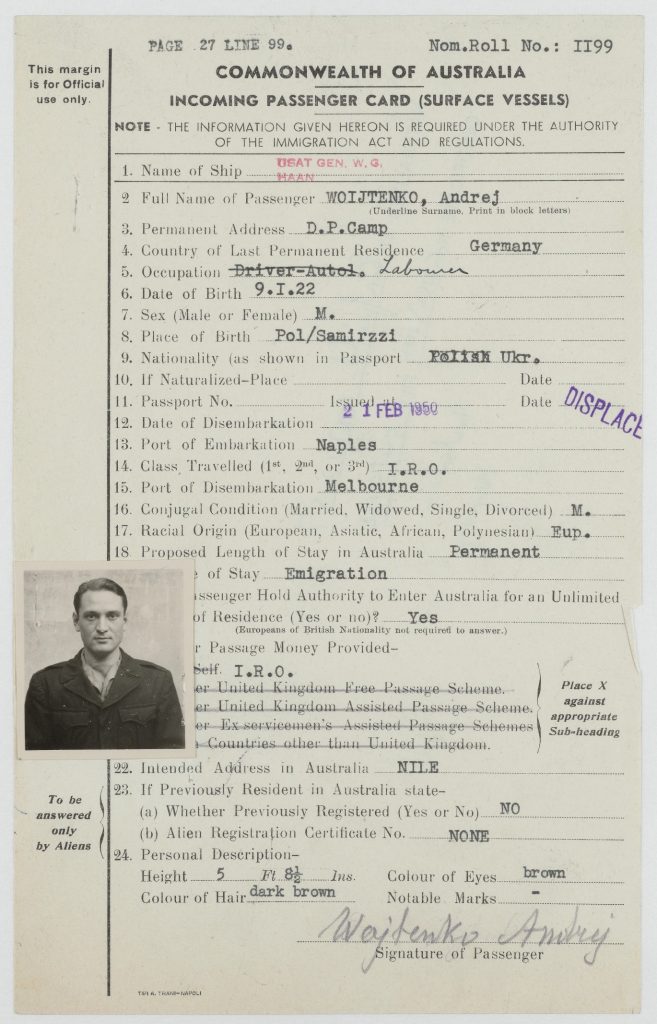
Incoming Passenger Card of Heinrich Wagner. National Archives of Australia: D4878, WOIJTENKO A
The possibility of revoking the citizenship of people such as Wagner and of deporting them on the basis that they had gained entry by false representation – an approach used in other jurisdictions – was discussed by Andrew Menzies in his report.
Menzies cited the Australian Citizenship Act of 1948 in noting that the Minister may revoke the Australian citizenship of a person who became an Australian citizen otherwise than by birth and ‘who has been convicted of an offence against section 50 in relation to the application for his certificate of citizenship; (this section makes it an offence to make a false representation or statement of conceal a material circumstance for a purpose of, or in relation to, the Act).’
However, Menzies also pointed out that the application of this paragraph of the Act ‘is limited by the fact that prosecutions for offences under section 50 of the Australian Citizenship Act must be commenced within ten years of commission of the offence.’[i]
[1] A.C. Menzies, ‘Review of Material Relating to the Entry of Suspected War Criminals into Australia’, Canberra: Australian Government Public Service, 1987, pp. 156-57.
Ervin Viks was an Estonian immigrant accused of the murder of some 12000 Jews and Roma at the Tartu concentration camp. In early 1961 the Soviet Union requested the extradition of Viks from Australia to the Soviet Union to face justice.
Australia’s attorney-general in the Menzies government at that time was Sir Garfield Barwick. Barwick’s response to the Soviet request was to note that there was no formal extradition treaty between the two states, that Australia was under no obligation to surrender Viks, and that Australia did not formally recognise that the country where the alleged offences took place was legally part of the Soviet Union. The request was denied.
Barwick then gave a speech to the House of Representatives, making it clear that the decision to deny the Soviet request was based as much in politics as it was in law. He expressed a view, widely shared at the time, that the time had come ‘to close the chapter’ on the crimes of World War II:
Two deep-seated human interests, however, may well here come into conflict. On the one hand, there is the utter abhorrence felt by Australians for those offences against humanity to which we give the generic name war crimes. On the other hand, there is the right of this nation, by receiving people into this country to enable men to turn their backs on past bitternesses and to make a new life for themselves and for their families in a happier community. This has formed a precious part of the heritage of the West, in which Australia has an honourable share.
In a given case the choice between these two human interests may present a government with a difficult decision. In the present instance, however, the Government came to the clear conclusion that, all questions of legal obligations apart, if such a choice had been necessary to resolve the matter, its right of asylum must have prevailed. Australia has established a thorough, though of course not infallible system for sifting and screening the hundreds of thousands of migrants who have enriched our national life since the World War. In default of a binding obligation requiring Australia at this point of time to do otherwise, those, who have been allowed to make their homes here, must be able to live, in security, new lives under the rule of law.[i]
The Soviets wrote to express their disappointment at the denial of their extradition request and to reiterate it, but they did not receive a reply. They nonetheless pressed ahead with the trial of Viks and two co-defendants in the Supreme Court of Estonia in January 1962. Only one man, Juhan Jüriste, appeared in person, as the third accused, Karl Linnas, could not be extradited from the United States.
The Estonian court handed death sentences to all three men. The decision was conveyed to the Australian government and Viks’s extradition again requested, but without reply. Jüriste was executed in March 1962. Linnas was deported from the United States to the Soviet Union in 1987 and died in a Soviet prison hospital in the same year.
Viks lived the rest of his life in Australia until his death in 1983. Some time later the SIU examined the evidence against Viks from the 1962 trial and concluded that, had he still been alive, he would have been one of the SIU’s major investigations.
[1] House of Representatives, Hansard, 22 March 1961, pp. 451-52.
This website includes photographs, personal accounts and historical material that some visitors may find confronting. It is not recommended for those under 13 years of age. Please explore at your own pace and take time to reflect before you leave this website.