
Witness testimony in the Adelaide war crimes cases brought accounts of Nazi occupation and the Holocaust into an Australian courtroom decades after the events. Some of those who testified were Jewish witnesses who had escaped the Holocaust and settled in the United States, Canada or Israel. Others came from Ukraine and described events they had seen in or near their villages during World War II. The courts also heard from historians, archivists and forensic specialists, whose evidence helped explain the wartime setting and the findings from investigations in Ukraine. Each witness could speak to different aspects of the case. A historian might explain how German occupation authorities were organised, while an eyewitness could describe an event from the place where they stood. For the court, the detail of an account mattered, including whether a witness had seen an event directly or heard about it from someone else. The passage of time made those distinctions harder to establish. So did the need to interpret testimony across languages and explain unfamiliar courtroom procedures to witnesses who had grown up under a different legal system. One of the accounts featured in the Justice Delayed exhibition is that of Dimitry Kostyukhovich, a Ukrainian witness who described what he saw at a mass killing site. Reading his testimony gives visitors a sense of how a courtroom exchange can preserve a personal account while testing exactly what the witness remembers. The exhibition also shows why eyewitness accounts mattered alongside records and forensic findings. The accounts preserved details of what happened to Jewish communities under Nazi occupation and gave the court evidence to examine in relation to individual charges. Those two functions help explain why the testimony remains important to readers today, both for understanding the experiences of people who lived through these events and for following the Adelaide proceedings.
Apart from expert witnesses such as historians, archivists and forensics experts, Adelaide courts heard testimony from eyewitnesses who had lived through World War II.
Some were Jews who had escaped the Holocaust and made their way to the United States, Canada or Israel. Others were from Ukraine, which in late 1991 had gained independence from the Soviet Union.
The Ukrainians had little experience of the world outside their towns and villages. The principles and culture of the Soviet legal system they knew, and the political context in which it had operated, were vastly different from those of the Australian system.
Difficulties in interpretation bred misunderstanding and contributed to inconsistencies in the witnessesʼ evidence. The passing of time meant that distinctions between the witnessesʼ experiences and hearsay had become blurred.
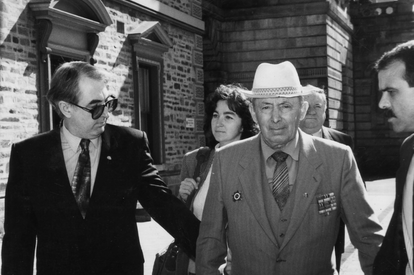
Q: What did you see?
A: I saw there in the pit. As they were entering it was not seen how they were getting into it because the pit was very deep and it was not visible from the side, but when I had a look I saw that they lay in there in the row one next to each other, and there was a lot of blood poured there along this corridor.
Q: And when you saw that, did you get upset?
A: Well because there was simply movement, terrible.
Q: Were the people in the pits still moving.
A: All moved.
As his medals indicate, Dimitry Kostyukhovich was a war hero. Before the war he had lived on a farm next to Ivan Polyukhovichʼs sister. In the war he fought with partisans; later he served in the Red Army. In the committal he testified that he had seen Polyukhovich shoot dead two boys. There were inconsistencies between evidence he had given in 1990 and evidence he gave at the committal. The trial judge, Brian Cox, did not allow Kostyukhovichʼs evidence to be presented to the jury.
SIU investigator Anne Brettingham-Moore discusses the categories of witnesses.
Audio: Brettingham-Moore.2.On witnesses
Source: State Library of South Australia. Interview with Anne Brettingham-Moore. Sound recording, Sydney, 28 September 2024. Interviewer: Peter Monteath. OH 1204/1.
Lindy Powell and Gabby Brown on the lack of reliability of the Ukrainian witnesses.
Audio: Powell and Brown.7. Ukrainian witness reliability
Source: State Library of South Australia. Interview with Lindy Powell and Gabby Brown. Sound recording, Adelaide, 7 March 2025. Interview by Peter Monteath. OH1204/11.
SIU interpreter Tanya Ryvchin discusses the challenges faced by Ukrainian witnesses when they appeared before court in Adelaide.
Audio: Ryvchin.2.Challenges in Adelaide for Ukrainian witnesses
Source: State Library of South Australia. Interview with Tanya Ryvchin. Sound recording, 27 September 2024. Interviewer: Peter Monteath. OH 1204/16.
Lindy Powell and Gabby Brown on the antisemitism of the Ukrainian witnesses.
Audio: Powell and Brown.4.Witness Antisemitism
Source: State Library of South Australia. Interview with Lindy Powell and Gabby Brown. Sound recording, Adelaide, 7 March 2025. Interview by Peter Monteath. OH1204/11.
Lindy Powell and Gabby Brown talk about the Jewish witnesses.
Audio: Powell and Brown.12.Jewish Witnesses
Source: State Library of South Australia. Interview with Lindy Powell and Gabby Brown. Sound recording, Adelaide, 7 March 2025. Interview by Peter Monteath. OH1204/11.
The SIU supported the work of the prosecution in Adelaide. That meant not only ensuring that witnesses were available for their court appearances but also, as SIU investigator John Ralston explains, themselves appearing as witnesses.
Audio: Ralston.11.SIU work in Adelaide
Source: State Library of South Australia. Interview with John Ralston. Sound recording, Sydney, 16 June 2024. Interviewer Peter Monteath. OH 1204/8.
Anne Brettingham-Moore, an investigator with the Special Investigations Unit, describes her experiences in accompanying Ukrainian witnesses back to Ukraine after their appearance in Adelaide.
Audio: Brettingham-Moore.1.On Ukrainians
Source: State Library of South Australia. Interview with Anne Brettingham-Moore. Sound recording, Sydney, 28 September 2024. Interviewer: Peter Monteath. OH 1204/1.
The following is an extract from evidence in the Polyukhovich trial given by Jack Kriniuk (or Krinick). He was born in Sernyky in 1928, where his father ran a grocery store. He managed to escape the killings in Sernyky. After the war he made his way to New York, where he accumulated a fortune as a clothing manufacturer.
Source: Collection of papers held by the defence in relation to the Polyukhovich trial, volume 4.
Q.
What occupation did your family follow?
A.
My father and mother had a grocery store and wholesale grocery which we were supplying most of the merchandisers in the surrounding towns, to the local grocery stores and bakeries.
Q.
And can you describe the relations between the Ukrainian and Jewish people at the time that your father’s store was operating?
A.
The Jewish people and the Ukrainian people had an excellent relationship. We worked together, we traded together and we went to school together and we were friends. Like I lived on Neier Dorf [new village] with mostly Ukrainian people, only about 10 Jewish people. It was mostly Ukrainian people, and I remember having Ukrainian friends that went to school together. I would say we had an excellent relation.
Q.
Did this change, these relations between the Jewish people?
A.
Relations changed in 1941 when the Germans occupied Soviet Union.
Q.
You mentioned a moment ago about the Soviet Union being in control of this area in 1939. Could you just very briefly describe to his Honour what happened at the time when the Soviet Union took over control of the town?
A.
When the Soviet Union came in they confiscated most of small business from the owners of the stores, whatever they had there. And a lot of people, from not only Serniki, from different parts, they took away and sent to Siberia. They confiscated our store, took everything away from us, and they had, the people who worked for my father, had to get together and decided whether to go to Siberia or whether he stays and there was an unanimous decision he should run the business as an employee of the state and we stayed on there.
Q.
In 1941 you said the Germans –
A.
Germans occupied, yes.
Q.
Can you recall what happened at the time when the Germans occupied?
A.
When I recall the first time the Germans came in on horses on our town. First time we saw Germans and round up mostly men, and they took them to the cemetery and they killed them there.
[In relation to the following year:]
A.
The ghetto was, they were taking all the Jewish people from surrounding areas and brought into Serniki. Our house which was the Neier Dorf over the bridge was the first house of the ghetto. And I would say the last house of the ghetto was the post office, a little behind the post office, that’s where it finished, the ghetto. The Ukrainian police were – it was not fenced ghetto, it was just open ghetto, but it was checked very thorough by the Ukrainian police, and if you went out where the ghetto finishes you would be killed right away.
Q.
How did you know where the ghetto finished?
A.
Who told you?
Q.
The Ukrainian police kept us informed.
Q.
Were the Jewish people required to do anything else other than live in the Jewish ghetto?
A.
No, required to wear yellow patches, one in the front, one in the back.
[…]
Q.
Before the break you were telling us about an incident when the Ukrainian police came into your house. Can you tell us about that?
A.
They came into our house at night. We were sleeping, already they woke us up. We were sleeping and they work us up, and they took my older sister and they raped her and made us all watch. I turned away my face, and they turned me and hit me, make sure I watch it. And I was crying. I was only 13 years old then, and they finished whatever they had to do. They left. My sister walked over to me and said ‘Don’t cry, don’t cry. I’ll be all right I’ll be all right’. If I may, I would just like to speak a little about the Jewish and Ukrainian people relation that we had. I think it is important, explain the life we had with the Ukrainian people. We had an excellent relation, we were friends. We were trading, we were going to school together. We shared food. We went on hikes and the Stubla [River], we were bathing, and I think it’s the majority of people from Serniki, Ukrainian people were sorry what happened. They tried to hide Jewish people. They tried to make sure as many as they could survive. And they give us food and they explained their feelings how much they are hurting about what is happening. And if there wasn’t a war I’m sure we would still be there and be a happy family.
Q.
Approximately how old was your sister at the time?
A.
My sister was 21 years old.
Q.
A few days before Rosh Hashana in 1942, can you remember what happened then?
A.
My sister was working as an accountant in a store and some Ukrainian people who worked there came to us and said that they dug fresh graves and they will kill all the Jewish people and they suggest we should run away but, you know, you don’t believe this. You don’t believe that a thing like this could happen. So we stayed on and one night we saw the lights of trucks coming in and we knew that’s the Germans that are coming to kill the Jewish people in Serniki and we all run away. We live not far from a forest. We went to the forest. And as we were running away my mother and my sister separated from us. We heard that the shooting and the killing was going on the next day.
Q.
Did you hear it yourself?
A.
Yes, we heard the shooting, yes. Serniki is a pretty open town and you could hear it for miles what is going on.
[…]
Sergei Potapovich Polyukhovich – no relation to the accused Ivan Polyukhovich – was an important witness because he had been present at the Sedrnyky pit killing in September 1942. He was born in 1925. He gave evidence in Ukraine in the form of a recorded interview with Keith Conwell and Anne Brettingham-Moore of the SIU on 1 May 1992.
Source: From the collection of the defence in the Polyukhovich case, Prosecution Witness Statements, vol. 3
Q.
Where do you live?
A.
I lived in Serniki and now I live in Zarechnye. I used to live where the Jewish population were killed. I lived at the place where Ivanechko’s father-in-law lived and we were friends with him, we used to walk together. He lived with his first wife and then his first wife left him and then he took another wife.
Q.
You know Ivanechko is his street name, do you know what his other names were?
A.
Another name for him is Polyukhovich, Ivan Timofeyevich. I live next door, some 200 metres from him and we used to play together.
Q.
Was that in Serniki?
A.
Yes, it was in Serniki. Not in Serniki itself but on small villages or stations. It was a small village.
Q.
Where were you living when the Germans occupied Serniki?
A.
We lived 2 kilometres away from Serniki. Where his father-in-law lived and is that where place we live. There were ‘khutors’ there during Polish times.
Q.
Is that the father-in-law to his first marriage or his second marriage?
A.
First wife’s father and his second wife was from Alexandrove and then he lived in Alexandrove.
Q.
Did he have any children to his first wife?
A.
No he had none.
Q.
Did the second wife have children?
A.
I don’t know because he took her and immediately left from that place. He took the new wife with the children.
Q.
Were they boys or girls?
A.
Girls. They live there somewhere. I will not recognise them right now.
Q.
You were living in Serniki when the Germans occupied. Do you remember what month and what year that was?
A.
It was autumn and we picked up potato and I do not remember what day or month this actually was. In September or October.
Q.
What year?
A.
I do not remember because maybe I will make a mistake. I can’t remember the year.
Q.
When the Germans came what did Ivanechko do?
A.
He served for German police.
Q.
Did he wear a uniform?
A.
He had one.
Q.
What kind of uniform?
A.
Black, blackish, dark blue.
Q.
Did he carry any weapons?
A.
Of course he carried, he could not be without arms.
Q.
What did he carry, a rifle or a pistol?
A.
I don’t know what he had but he had something with his uniform.
Q.
When the Germans came the Jews were all put into a ghetto, is that right?
A.
There were about 200 Germans and they stayed in an old school building. They didn’t first do any harm to the Jews.
Q.
What eventually happened to the Jews?
A.
There was a certain area in the village which was surrounded by barbed wire and there were the houses. In each house there lived 5 or more families. It was the ghetto where the Jewish population lived. No-one was allowed there.
Q.
What happened to the Jews in the end?
A.
They stayed there for about one month longer and somebody told them that they would go as labour force for a kind of work. Nobody told them that would be killed.
Q.
Do you know what happened to them?
A.
Yes, I know.
Q.
You tell me what you know.
A.
At first pits were made. A pit with a dimension of 40 metres long and 12 metres wide and here was a path a depth of about 2 metres dug and they were placed 12 persons at a time with their heads towards the wall in a row and another row after this row. Usually mothers took small babies beneath themselves, whether they were killed or not.
Q.
How does he know this?
A.
Because I was standing some 150 metres away from the place of mass shootings as they were taken to the pit. Our policeman allowed us to stay and have a look at them.
Q.
Being shot?
A.
So they were first taken to the pit and Rabbi delivered a speech before them and said that because we just betrayed Jesus Christ and crucified him this is our dreadful sin and we should suffer for your dreadful sin. He said them to pray before their death. After that they were undressed, the first person who undressed was the Rabbi himself. Then the rest of them were undressed and in a row in a single file of 12 persons they were forced to go down into the pit. Those who didn’t want to go down were beaten with a whip.
Q.
Did you hear the Rabbi say these things?
A.
Yes he could hear.
Q.
How far away were you standing from the pit?
A.
150 up to 200, very close. We were allowed to stay there.
Q.
To hear what the Rabbi was saying, he must have been speaking in a loud voice?
A.
Yes he spoke in a loud voice. He took his book, it was a special book he had. He carried, he read aloud and after that all of them prayed separately.
Q.
How long did you stand there watching and listening to this?
A.
During an hour and a half, all this was already finished after this.
[…]
Q.
Was there anyone from Serniki there?
A.
Maybe someone was from Serniki, it was a long time ago you see I can’t remember. Ivanechko, Polyukhovich Timofeyevich he was there. And there were several other people from the village.
Q.
What was Ivanechko doing there?
A.
As for the local policemen did nothing there. Only one person did the shooting, the rest were safe guarding them so that they would not escape. Wouldn’t allow them to escape.
[…]
Q.
You have got no doubt that Ivanechko was there at the pit when these people were being shot?
A.
Yes he was present.
Photos
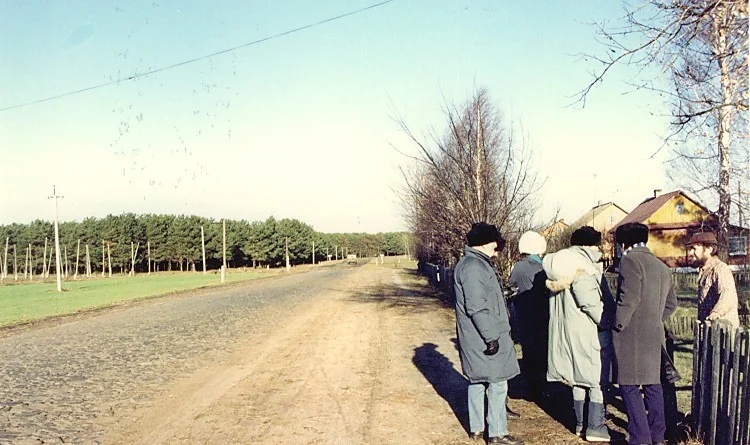
Australian investigators speaking with witness Fyodor Polyukhovich (right) at the front of his property. On the left is the forest in which Fyodor identified the mass grave. He told investigators that on a September morning in 1942 he had seen Ivan Polyukhovich (‘Ivanechko’) among those escorting Sernyky’s Jews past his house to the pit dug on the site that after the war was covered by a forest. His identification of the exact site of the grave was crucial to the decision to charge Ivan Polyukhovich.
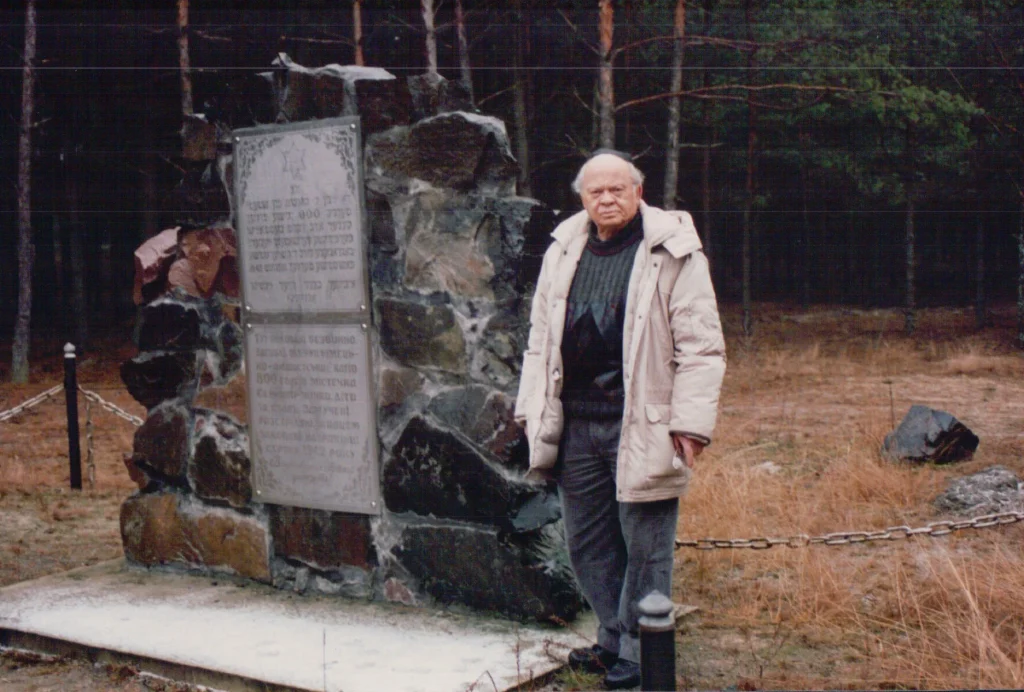
Survivor of the Sernyky killings Milton Turk, who emigrated to the United States after the war, photographed next to the memorial at Sernyky in March 1992. Graham Blewitt.
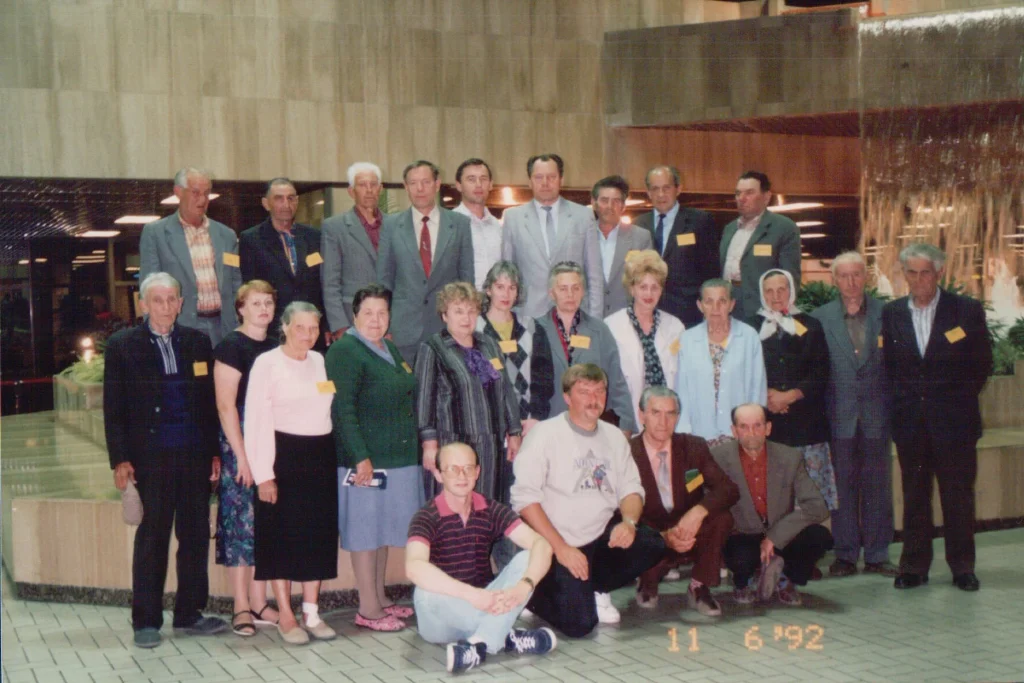
Airport gathering of Ukrainian witnesses in the Heinrich Wagner case. Graham Blewitt.
This website includes photographs, personal accounts and historical material that some visitors may find confronting. It is not recommended for those under 13 years of age. Please explore at your own pace and take time to reflect before you leave this website.