
The site of the killing of Sernykyʼs Jews in September 1942 had since then been covered over by a forest, but its location was remembered by a local man, Fyodor Grigoryevich Polyukhovich.
The discovery of the first human remains confirmed the reliability of Fyodorʼs memory and contributed greatly to the decision to charge Ivan Polyukhovich – no relation to Fyodor.
Before the accused faced a committal hearing in Adelaide, the Special Investigations Unit undertook a thorough investigation of the site. An Australian forensics team was sent to Sernyky.
The forensic archaeologist Richard Wright and members of his team worked with a Soviet team to establish that a large, rectangular grave contained 553 bodies. Most victims had been shot; some had been clubbed to death.
The sandy soil had slowed the decay of the bodies; large amounts of human hair were visible. Among the bodies were other traces that gave insight into the victims, the perpetrators and the course of events that had unfolded in 1942.
This was the first occasion that a mass grave from the Holocaust was excavated for evidentiary purposes.
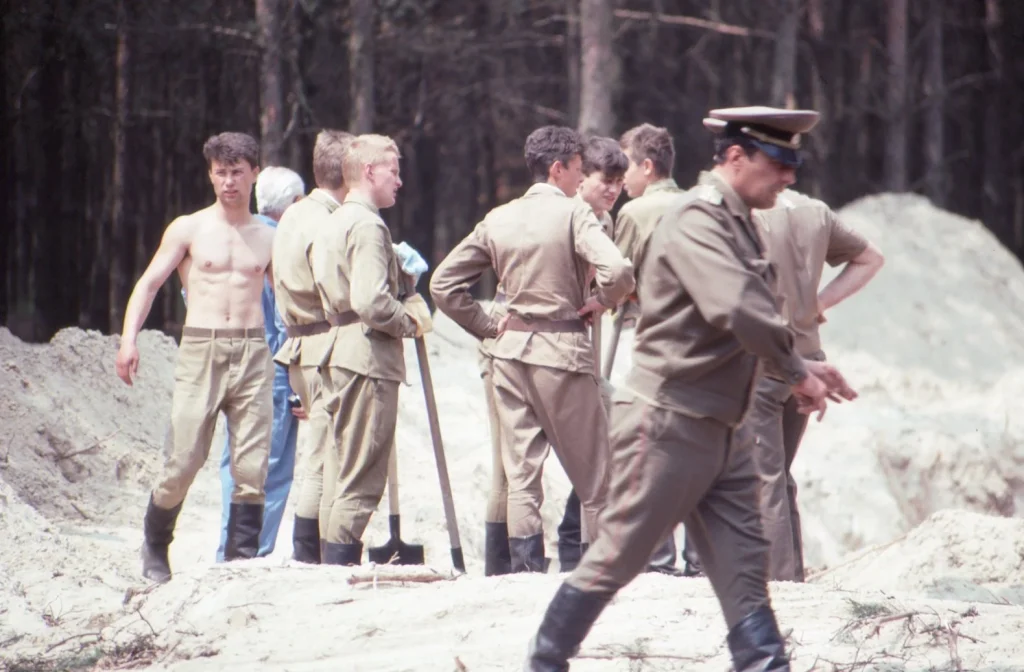
Red Army soldiers assist at the Sernyky mass grave. (Richard Wright)
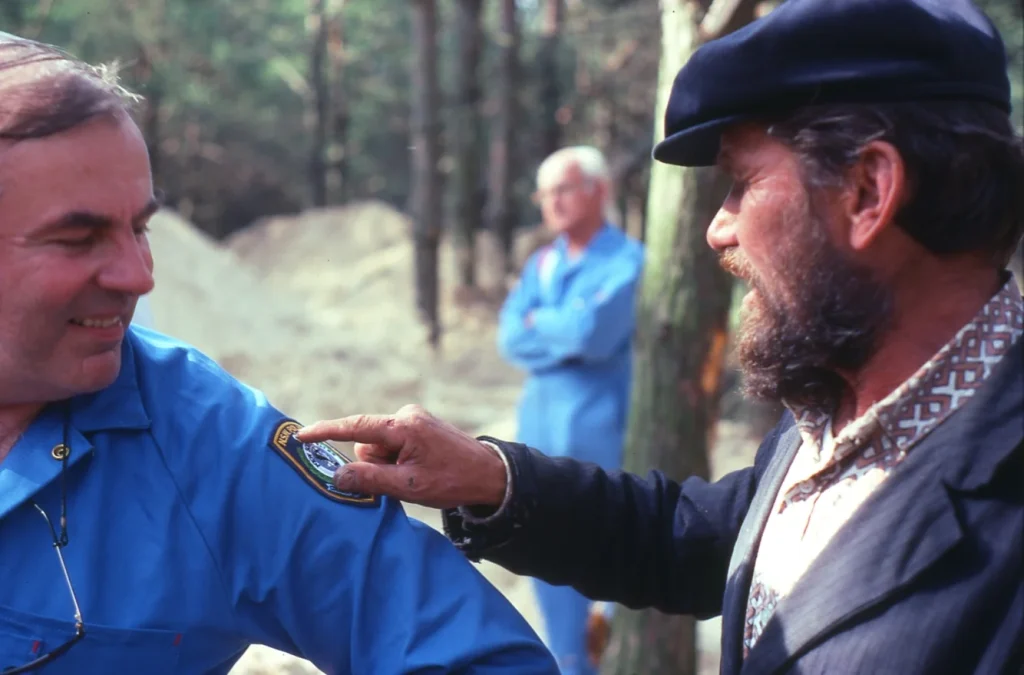
Fyodor Grigoryevich Polyukhovich, right, pictured here with David Hughes of the NSW Police, seconded to the SIU. (Richard Wright)
Among the interested observers of the work at the grave site in summer 1990 was Fyodor Grigoryevich Polyukhovich. On the day of the killing in 1942, Fyodor had seen the column of Jews as they were escorted past his house in Sernyky toward a pit already dug outside the village. That afternoon, he and his teenage friends had been forced to fill in the grave. He told investigators that he had seen Ivan Polyukhovich escorting the Jews to the pit and, later in the day, assisting Germans at the pit.
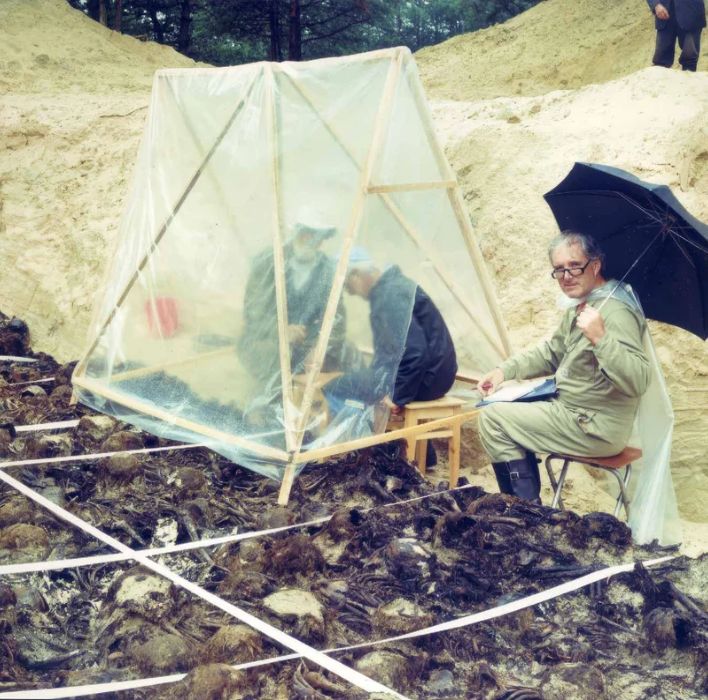
During drizzly rain, Godfrey Oettle and Bert Bailie are under improvised cover, analysing the bodiesʼ sex, age at death, and cause of death. Richard Wright sits outside taking notes. (Richard Wright)
The Soviet government supplied a small team of Ukrainian forensics experts and ten soldiers under the command of a lieutenant. The Soviets had assumed that the Australians would merely watch them doing the excavation. The Australians explained that, for evidential requirements, they would have to undertake the excavation and examination of the bodies themselves. The two teams worked together harmoniously, working from different ends of the grave.
Forensic archaeologist Richard Wright explains how the Sernyky mass grave, over which a pineforest had grown since World War II, was located. The key figure in identifying the site wasFyodor Polyukhovich – no relation to Ivan Polyukhovich – who claimed to have witnessed killingsat the site in September 1942.
Audio: Wright.1.Locating the Sernyky grave
Forensic archaeologist Richard Wright explains what was found at the Sernyky site, in particularthe three components of the grave, and what the work undertaken there revealed about whathad happened at the site in 1942.
Audio: Wright.2.Sernyky grave
Source: State Library of South Australia, Interview with Richard Wright. Sound recording,Sydney, 15 June 2024. Interviewer: Peter Monteath. OH 1204/15.
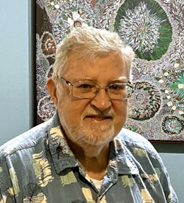
Deputy director and then director of the Special Investigations Unit Graham Blewitt discussesthe value of the forensic evidence gathered by the Australian and Soviet forensic archaeologistsat Sernyky in the Polyukhovich case.
Audio: Blewitt.9.on the value of forensic evidence.
Source:State Library of South Australia. Interview with Graham Blewitt. Sound recording,Sydney, 21 November 2023. Interviewer: Peter Monteath. OH 1204/5.
Richard Wright discusses the reaction of the local population in Sernyky to the work ofuncovering the mass grave.
Audio: Wright.3.Serrnyky locals
Source: State Library of South Australia, Interview with Richard Wright. Sound recording,Sydney, 15 June 2024. Interviewer: Peter Monteath. OH 1204/15.
Richard Wright describes the ceremony held at the conclusion of the work at the Sernyky grave.It was attended by, among many others, SIU director Bob Greenwood.
Audio: Wright.4.Graveside ceremony Sernyky
Source: State Library of South Australia, Interview with Richard Wright. Sound recording,Sydney, 15 June 2024. Interviewer: Peter Monteath. OH 1204/15.
Richard Wright discusses the assistance given by the Soviets in undertaking the work to find themass grave at the Ustynivka site in Ukraine for the Wagner case.
Audio: Wright.5.Soviet help in the Wagner case
Source: State Library of South Australia, Interview with Richard Wright. Sound recording,Sydney, 15 June 2024. Interviewer: Peter Monteath. OH 1204/15.
Richard Wright discusses the work and the findings at the Ustynivka site in the Wagner case.
Audio: Wright.6.Ustynivka excavation
Source: State Library of South Australia, Interview with Richard Wright. Sound recording,Sydney, 15 June 2024. Interviewer: Peter Monteath. OH 1204/15.
Richard Wright discussed the forensic evidence at Hnivan in the Berezovsky case.
Audio: Wright.7.Berezovsky case
Source: State Library of South Australia, Interview with Richard Wright. Sound recording,Sydney, 15 June 2024. Interviewer: Peter Monteath. OH 1204/15.
The late Sonia Wright was a member of the Australian team that undertook a thorough examination of the mass grave on the outskirts of Sernyky in June and July 1990. The Australians worked closely with a Soviet team headed by Edward Sharayev. At the disposal of both teams was a small unit of Red Army soldiers. Later Sonia Wright would be part of the teams that worked on similar World War II-era mass grave sites at Hnivan and Ustynivka.
The diary she kept at Sernyky provides an invaluable record not only of the daily tasks performed but of how she and others coped with the challenges of working among bodies still in a state of decomposition.
The diary has been made available by the Sydney Jewish Museum. It is used with the permission of Richard Wright.
Richard has been to his first meeting at the Special Investigations Unit. The boss is Bob Greenwood QC. It was explained that the SIU is investigating allegations against Ivan Timofeyevich Polyukhovich, now an Australian citizen living in Adelaide. He has been charged with taking part in the killing of several hundred Jews at Serniki. The killing supposedly happened in the Ukraine in 1942. There is supposed to be a mass grave near the village of Serniki.
It is a relief to hear that so much background work has been done in cooperation with the Ukrainian authorities. Richard has been having bad dreams of turning up at Moscow airport and telling the authorities that he has come to look for a mass grave. He was also pleased with the professionalism of the people at the meeting, which included the two principal investigators Bob and Anne. They have spent many weeks at Serniki with the authorities and witnesses.
Richard thinks excavating now, in the northern early spring, would be difficult. It is better to wait until the early summer when the melt waters have drained away. If the grave is in boggy ground then a water pump is needed, and a bulldozer or backhoe for clearing the surface and digging drainage trenches. He was asked to write a proposal of what he might need and he was also asked if he wanted to take an assistant.
[…]
[…]
The prosecution lawyers flew up from Adelaide for the meeting, to outline the legal requirements for carrying out an exhumation in USSR. They told us to concentrate on determining the method of killing, and look for indications of when it took place. Since the previous meeting the local authorities have dug a small hole at where the grave is thought to be. We looked at a murky photo of the hole, and were relieved to see signs of pale sand. They say the bones in the photo are only 25 centimetres down. At this shallow depth, the soil is likely to have oxygen penetrating it, which will have encouraged the decay of soft tissues.
[…]
[…]
The forest pines around the clearing are about 10 metres high. The sand is white and smooth beneath a layer of pine needles. A dark bearded man, with a somewhat wolf-like, lined face, came to introduce himself. He was from the village. His name is Feodr [ie Fyodor Polyukhovich]. I could not guess at his age. Although he walked with a limp, and carried a stick, he stood straight and spoke strongly. He said that the SS had made him fill in the grave after the killing on 22nd September 1942. Then he pointed to where he thought the grave is.
We asked about the hole they had dug, and were shown a rough patch some 30 metres away from where Feodr had pointed. ‘Why were bones found there’, we asked? ‘But that is also the grave’, Feodr said. ‘It is about 50 metres long’.
He also recounted that the grave is 2.5 metres deep, not 0.25 as we had been told in Sydney.
[…]
Edward and I slithered down the loose sandy slope into the grave. On the floor there were a few tree roots poking up, the sole of a shoe and the clean dome of the back of a skull looking like a coconut washed up on a beach. Here and there were grey patches in the white sand, with scatters of blackish bones. Up on top the backhoe was working away at the north face. Down below the soldiers with their long shovels were digging out the sand that was beyond the backhoe’s reach and heaping it onto wooden stretchers. Then two of them carried the stretcher precariously up the loose soft sandy slope and tipped it out.
We began scraping and brushing the sand off the woman and child. Their heads were touching and the woman’s hair was red brown and done up in a bun. I brushed her hair obsessively, trying to get every sand grain off because I was reluctant to move onto her bones. As the sun rose higher I became aware of what I took to be a sweet musky aftershave Edward was wearing, and it was only after he had moved away that I realised the smell came from the bodies.
Exposing the woman and child became confusing. The bones of other individuals lay across them and the more we uncovered the more of a jumble it seemed. I could not work out the alignment of the bodies. As I shifted my position the bones under the sand beneath me grated and became displaced. Some scarlet dentures slipped out from under a skull. There was a green stain in the sand beside it, probably from a cartridge case. Some of the bones still had brown leather skin around them, and there was some hard white plastic looking stuff near a pelvis, which Godfrey said was adipocere or grave wax. Richard told me that the grey patches were caused by organic material from the bodies, spreading out into the sand.
There seems to be little point in continuing our manual work at this stage. We have opened merely a window into the grave and with this information have to decide now how best to uncover the bodies with the least disturbance.
[…]
News comes that the soldiers have found something. It is a silver pocket watch secreted in the toe of a boot. It stopped at 8.15. Was that morning or evening? Did it go on ticking after the killing was over and all else was silent. I am glad that its owner succeeded in deceiving the killers.
[…]
The soldiers began digging out the entrance ramp, working outwards from the floor of the grave. Very soon they came to that grey staining of the sand, which is the first indication of a body. The bones of a teenager lay parallel with the long axis of the grave, but in the fill at a level high than the bodies in the grave itself. Clearly this was a killing after the grave had been partially filled in. Mixed up with the teenager were the bones of baby. Also two bakelite buttons of the sort a baby would have on a matinee jacket, a small blue glass button with a moulding that looked grotesquely like the face on a modern Smily button, and a flat mother-of-pearl button. There was also some elastic. It looked as though these children had not been stripped of their clothing.
David X-rayed the teenager’s mandible. They compared the degree of tooth eruption with the Schour and Massler chart. This chart, compiled in the USA, is used by forensic investigators to assess the age of bodies up to the age of about 18. It illustrates how many milk and permanent teeth are erupted at six monthly intervals. The user tries to match the specimen with one of the pictures. We estimated our teenager was just over 12 years old.
Richard also had a chart by Maresh, which plots the average length of the arm and leg bones at various ages during growth. This chart makes the teenager to be only 10. The discrepancy arises because Maresh created his chart from a study of well-fed Americans. By contrast, the sequence of dental eruption is known to be little affected by diet. We thought the dental age of 12 more likely since these children would not have had much of a diet in the first years of the war.
The baby’s bones are too small to figure on the Maresh chart of limb bone lengths, but the dental chart shows it was about 6 months old when killed.
During the final stage of clearing out the ramp the soldiers discovered at its base the skull of an old woman. She had lost all her teeth during her lifetime and the bone had grown over the empty sockets. She had no signs of bullet holes, so it seems not everyone was killed by a shot to the head.
Sergei, the captain of the soldiers, is growing more confident with his English. He said quietly as he stood looking down the ramp: ‘This is the road to hell.’ It is a chink in the armour we have all put on, the first display of emotion I have noticed – except for Edward’s dogged insistence that we are going to expose the whole grave. Everybody has been behaving in a businesslike and dispassionate way. It was what I would have expected from Godfrey and David, because investigating violent death is their job. Richard and I were born in England, where school instilled sangfroid into us.
Anyway, we have little time for introspection. We work a long day, finishing about 6.30.
[…]
Another grisly day bent over black corpses. Nearly all of them are women and children. Of the hundred or so we have uncovered only two are adult males. Many of them still have hair plaited in a variety of styles. It gives them personality, which makes the job harder. I feel I am invading their privacy poking away at the sand around the pelvic bones. I sometimes mutter an ‘excuse me’ and promise I will tell what was been done to them.
I uncovered a particularly distressing sight today. It is a woman with her arm protecting the head of a little girl lying alongside her. I had to tell myself not to think about it, and to just get on with the job. If I needed to cry I can do it tonight. I never did. As the work got worse the evenings got better. We would walk home to bed, weary, a bit mazy, but relaxed.
Where the bodies are two or more deep, soft tissues have survived. There is fat, skin, tendons, brain, and toenails. Later we will have to count the bodies, so must dig out the sand between the bones to establish where the bottom of the grave is. In many places we cannot do this because of the mass of bodies and surviving soft tissue.
[…]
[…]
The work is much easier now because there is plenty of space around the skeletons. By the entrance ramp they are lying at all angles, but not face down and one on top of each other. Some had traces of wool around the arm bones. We found a belt buckle, knives, spectacles, and a lighter in what must have been a pocket. Some had rubber boots on their feet.
It is becoming clear that there were three distinct sessions of killing:
Richard commented on the inappropriate strategy he had worked out in Sydney. If we had sampled the grave as planned, we would have grossly underestimated or grossly overestimated the number of bodies, depending on where we had sampled. Edward was right to insist on digging the whole grave, to get a total headcount.
[…]
While we were sheltering in the tent, we were visited by a deputation of architects and officials from Rovno, led by Nadia the lady mayoress of Serniki. They wanted to discuss plans for a monument at the grave. Nadia often calls in to inspect our progress. She says her people are feeling shame and guilt for not having put some memorial there before. There are no longer any Jews in Serniki, so they are consulting the Jewish community in Rovno about what kind of monument to put up. They want us to estimate the number of people in the grave, so that they can put this statistic on the monument. Richard said that we should know by the end of next week. He told me that he feels a new emotion now – our responsibility to the local community. What had started off as a clinical job was now becoming significant to the locals.
[…]
[…]
A lot of rain has fallen over the weekend. The sand has absorbed it all, but unfortunately so have the desiccated soft tissues on the bodies. We resumed our post mortem work. My job was harder today, because the connecting ligaments had been revitalised by the rain and I sometimes had to cut with my trowel to sever the skull from the vertebrae. When doing a horrible job it helps to joke about it. I was crudely commenting that I must have beheaded more people than a medieval executioner when I hear someone sobbing. An elderly woman had been brought up from Rovno to see the excavation. She stood rocking and weeping at the edge of the grave. She told us she had been minding the cattle in 1942 when she saw the column of people being marched past to their deaths. She was very frightened at the sight of the column and ran away.
She recovered her composure while she spoke to us. Then she asked whether we had found any gold teeth or jewellery.
[…]
We finished the job today in hot sunny weather. The last skull was examined just before lunch. I was surprised at my great feeling of relief. The memory of the smell, the maggots and the dreadful sight of those eye sockets and gold teeth as I turned the skulls over, will fade with time I hope.
Richard says he feels a great sense of relief from responsibility. Instead of vaguely knowing that some atrocity was committed we can certify how many were killed and list their age and sex. We have done some sort of justice to the victims.
[…]
[…]
Rabbi Schmoule Bloch arrived. At first glance he seemed a rather loud, brash fellow. He was young and American. His response to every suggestion was: “That’s cool.” He came with a party of Jews from Rovno. One of them, a women in a red coat, began sobbing and wailing at the edge of the grave. Someone said her father was in the grave. She had been visiting an aunt in Pinsk when the killings happened. Her menfolk looked embarrassed, frowned and hushed her, but she was beyond listening. I went up and made some gesture of sympathy, which quietened her a bit.
When Nadia the mayoress arrived, it was decided to have the ceremony ahead of schedule because of the threatening clouds. As I had anticipated, everyone collected around the south east edge of the grave. We walked round to the other side, feeling we should set ourselves apart from the local mourners. We felt ambivalent about the ceremony. It was our excavations that had brought this day of mourning on the village.
Nadia began the ceremony with a speech delivered in a confident, piping voice. A man chanted a prayer. Bob [Greenwood] went down into the grave and stood with head bowed and hands clasped. There was a break in the proceedings. Twelve men went down with shovels and began covering the bodies with sand. This was a ritual to partly cover the bodies during the ceremony. Mel also went down, but some people felt this was inappropriate and beckoned him out. All the while people were drifting up through the trees. For some unexplained reason I found this sight of the villagers coming more moving than the ceremony itself.
The Rabbi made a speech. Bob made a speech. The Rabbi said: “Well, that’s all I can do for these people”. The wailing woman in the red coat walked halfway down the ramp and stood there forlornly. It was all over.
[…]
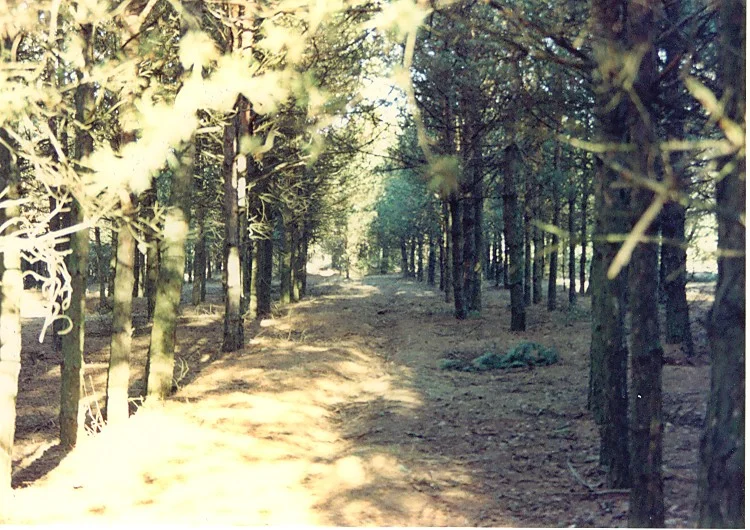
At the beginning of 1990 Soviet forensics experts, at the request of the SIU, undertook a sample dig at the forest site identified by Fyodor Polyukhovich. The Soviets found human remains at the site. Later that year, in June and July, Australian and Soviet teams working collaboratively undertook a thorough exploration of the site.
The photos below are provided by Richard Wright, texts are a result of discussions with him.
Witness Fyodor Polyukhovich, who had identified the grave site, with David Hughes, a policeman from NSW who was seconded to the SIU. Fyodor Polyukhovich was a keen observer of the work of the forensic archaeologists.
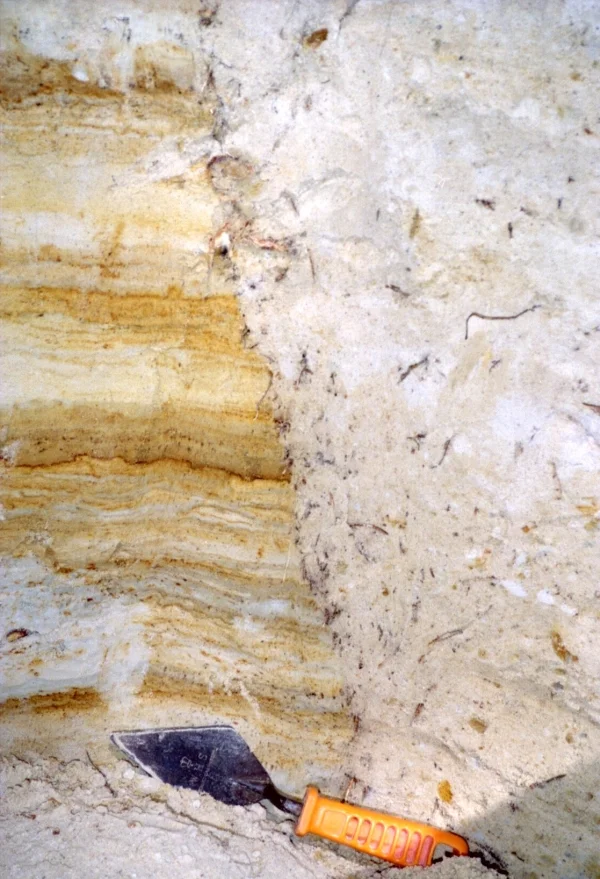
Thanks to Fyodor Polyukhovich, the general area of the mass grave at Sernyky was known, but nothing showed on the surface. Stratigraphic sampling was used to get the exact boundaries of the grave. The photograph shows natural iron stained soil on the left, the cut margin of the grave, and then the somewhat mottled refilling of the grave on the right.
The Soviet government supplied a small team of Ukrainian forensic experts, and ten soldiers under the command of a Lieutenant. The Soviets had assumed that the Australians would merely watch them doing the excavation. The Australian team explained that, for evidential requirements, they would have to speak to work the team had done in the excavation and examination of the bodies. It was therefore agreed that the Australians would start at one end of the grave, and the Ukrainian team at the other.
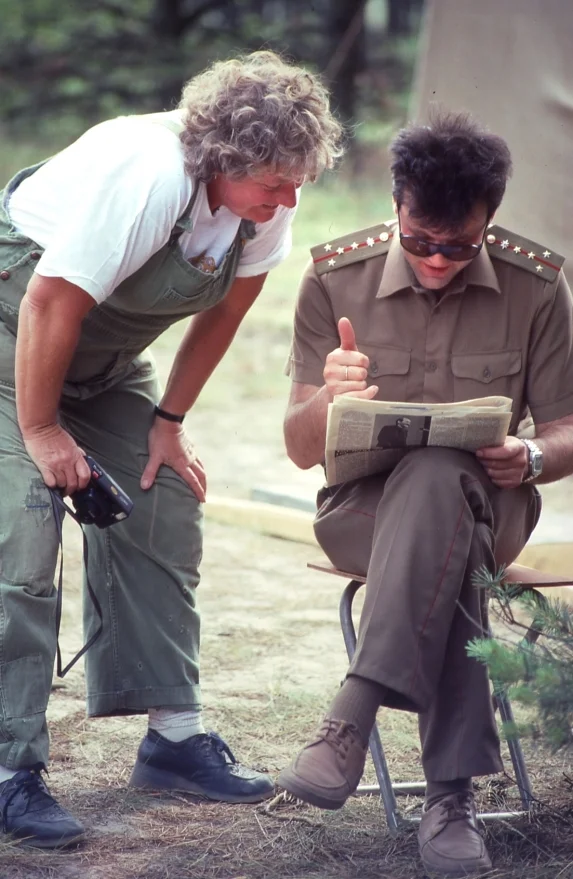
The Soviet Lieutenant reads Sonia Wright’s horoscope for the day.
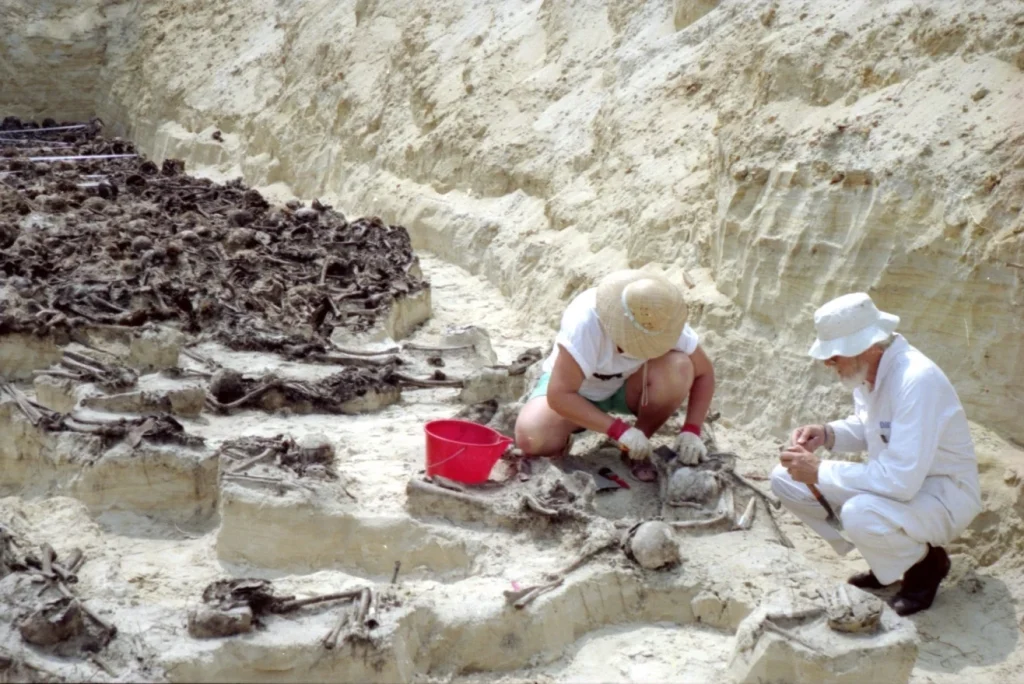
The massive overburden of tons of sand has now been removed from the graves, using a machine excavator and the labour of the soldiers. That large scale excavation stopped at a level just above the bodies. Then the bodies were gently uncovered by trowels and brushes. Sonia Wright is cleaning off the remaining sand, which allows Godfrey Oettle to determine sex, age at death, and cause of death.
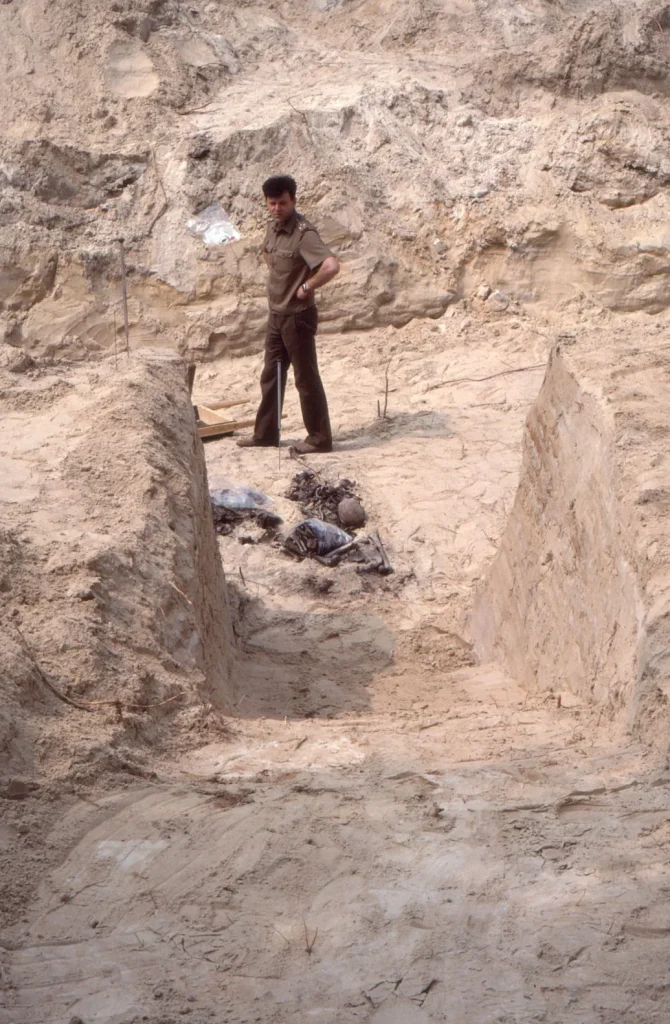
The Lieutenant looks up the ramp down which the Jews were herded into the mass grave. He knew enough English to call it the ‘road to Hell’.
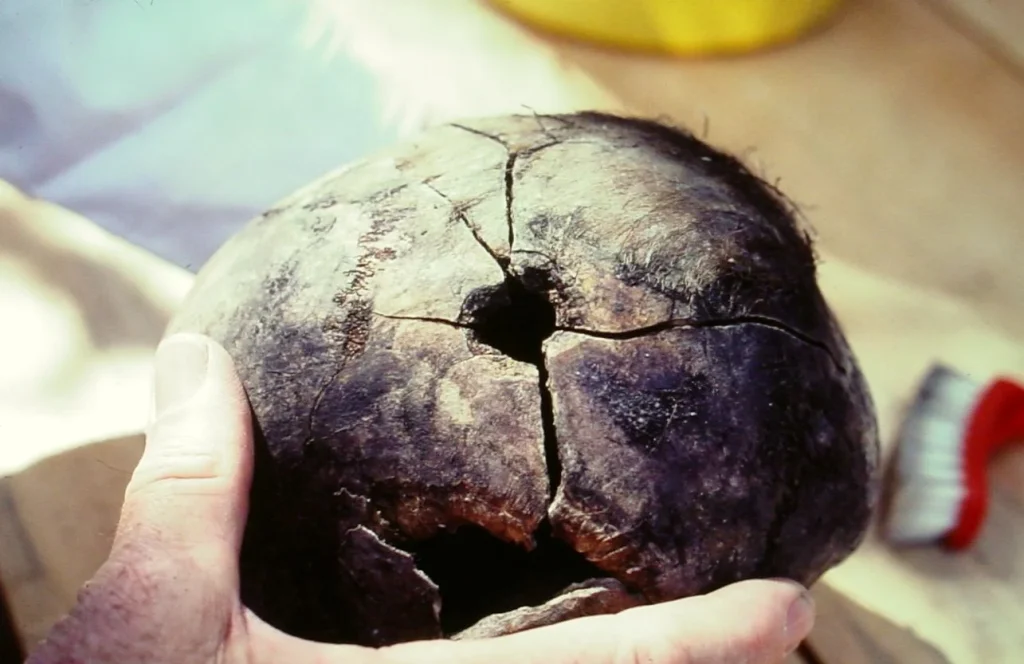
The exit hole of a bullet in the side of a skull. There will be an entry hole on the other side.
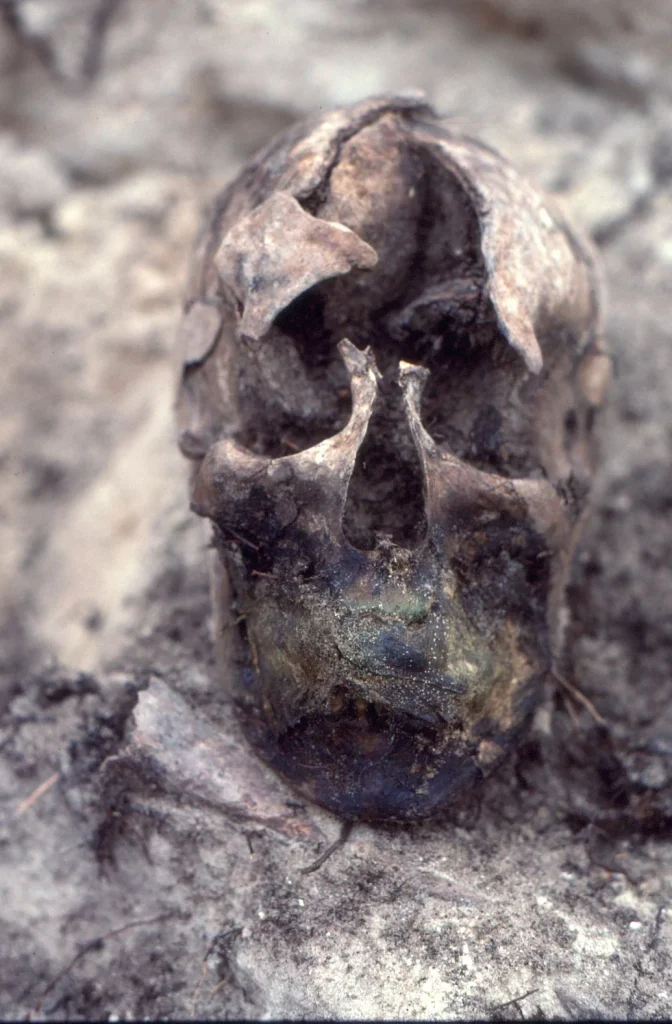
Most of the victims had been shot. However, in the middle of the grave there were a few bodies that still had their clothing and were lying irregularly. This woman had been gagged with green cloth, and heavily clubbed on the top of the head, causing massive inwards fracturing of the bones at the top of her skull. The death blow was possibly done with a rifle butt. A witness said that these bodies, in the middle of the grave, were Jews who had been missed at the first roundup.
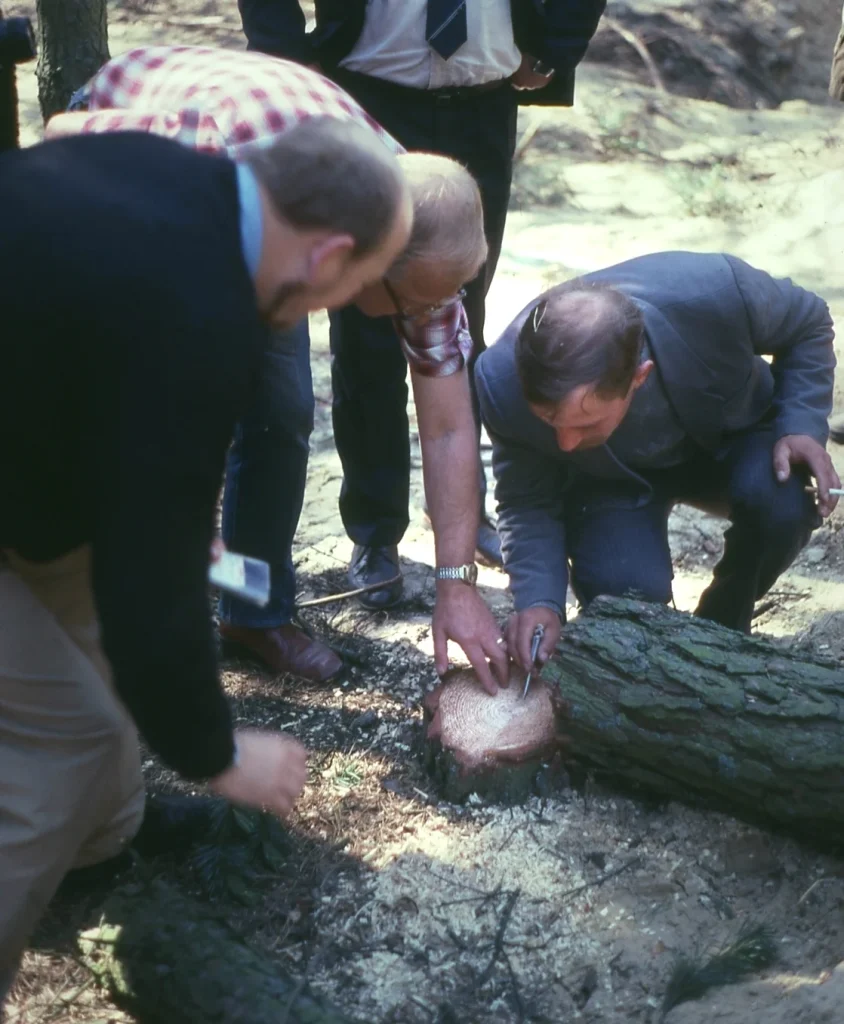
Pine trees had to be sawn down to get access to the mass grave. The stumps had annual growth rings that showed that the trees were planted in around 1967, i.e. 25 years after the murders in the mass grave in 1942.
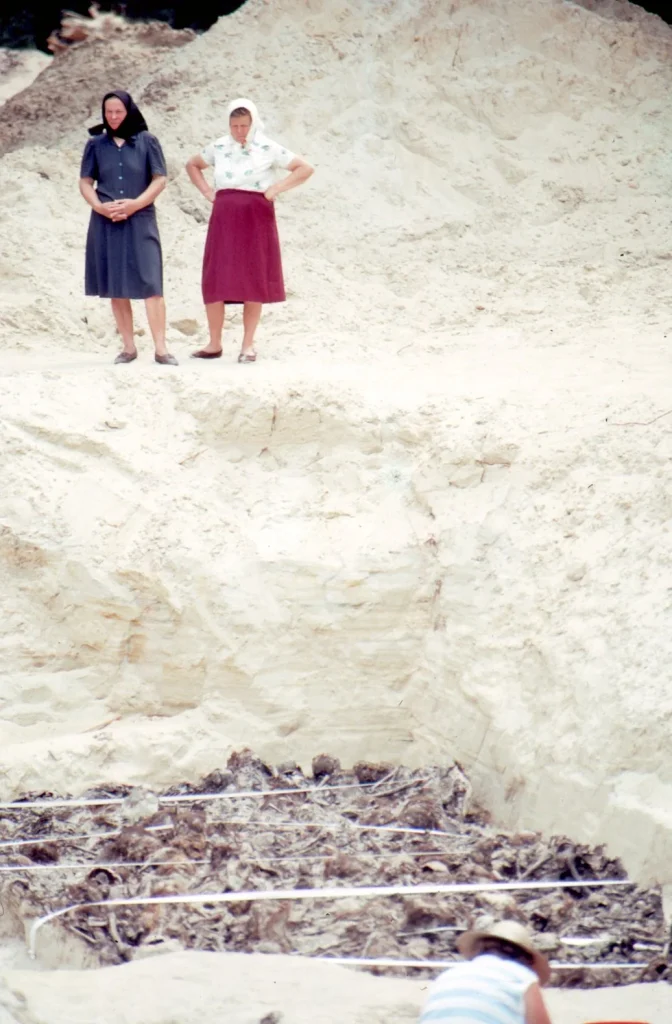
People from Sernyky used to wander into the forest and weep on the edge of the grave. The Captain originally told them to go away. Then the Mayoress of the village came and asked permission for them to come; some of them had friends in the mass grave. So the restriction was lifted.
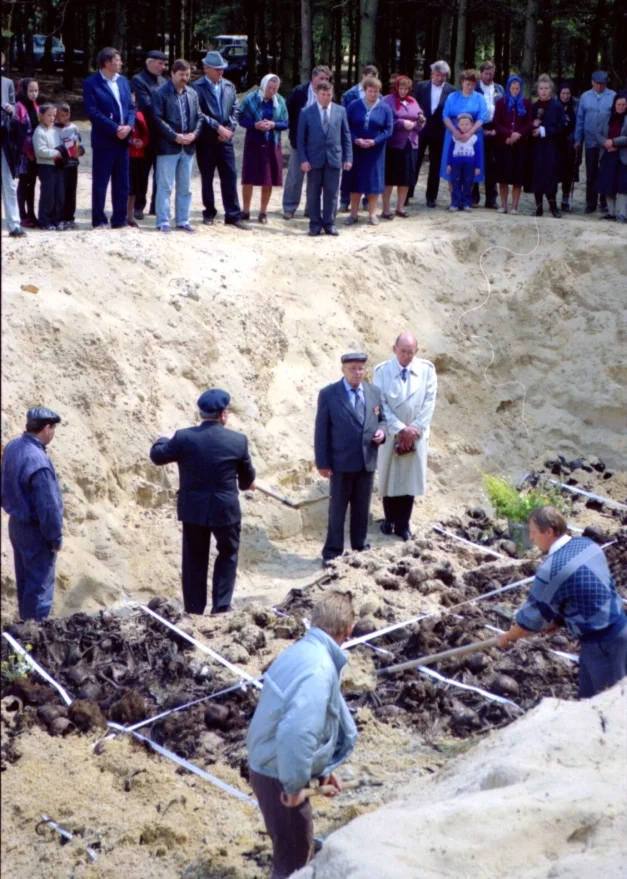
The bodies in the mass grave were not exhumed but were covered up again with sandy soil. The initial ceremonial covering up with sand was done by an American rabbi, with some Jews from the nearby city of Rivne. Villagers from Sernyky came to the ceremony in numbers. Present at the ceremony, in the grave and wearing a long coat, is Bob Greenwood KC, Director of the SIU.
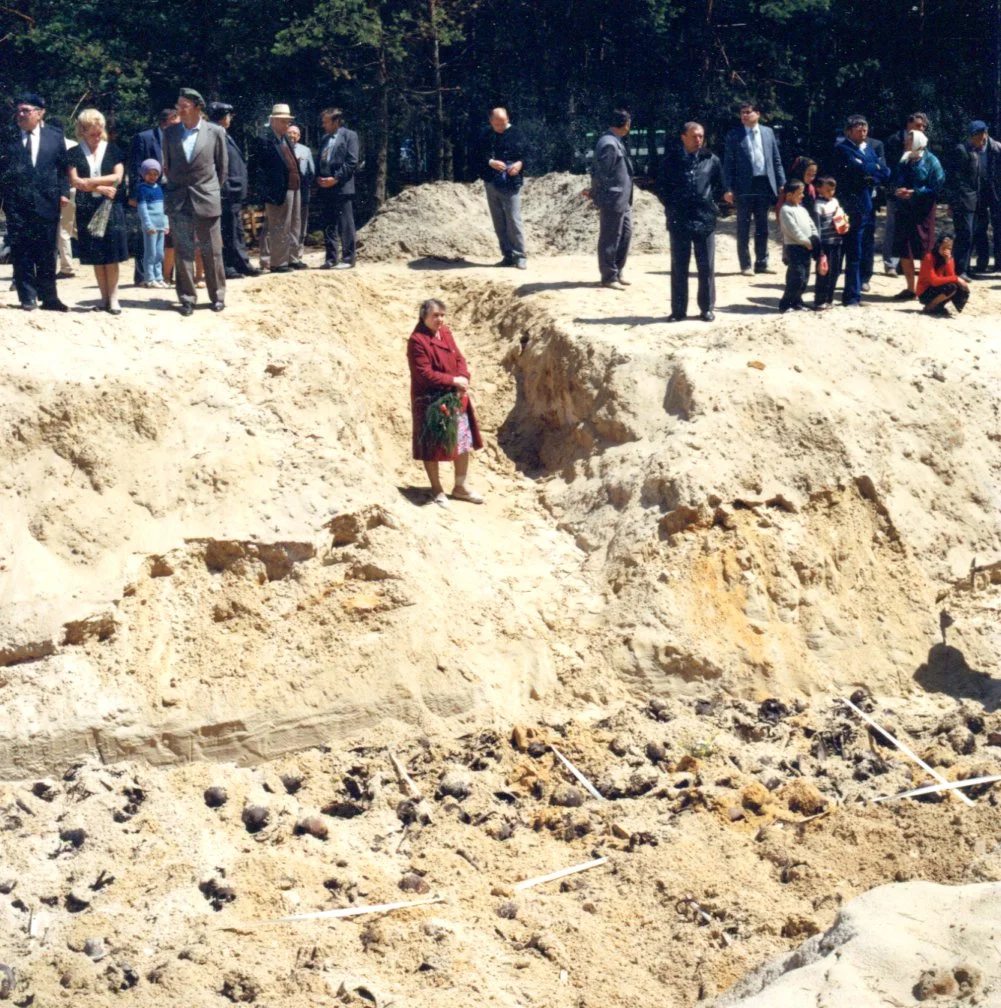
During the ceremony, a woman in a red coat started calling out to the assembled persons. As a girl, she had been staying away from Sernyky from July 1942 so avoided being murdered. Members of her family, though, were in the mass grave that she was looking into.
This website includes photographs, personal accounts and historical material that some visitors may find confronting. It is not recommended for those under 13 years of age. Please explore at your own pace and take time to reflect before you leave this website.